

Managing real estate investments used to mean spreadsheets, manila folders, and late nights running numbers by hand. In 2026, that approach simply cannot compete. Whether you own two rental properties in Ohio or manage a portfolio of commercial assets worth hundreds of millions across multiple states, the right software changes everything. It automates the work, sharpens your reporting, and gives you a clear picture of every dollar in your portfolio at any time.
This guide covers the best real estate investment management software available in the USA today, organized by investor size so you can find the right fit without wading through options that were never built for your scale.
Why Software Has Become Non-Negotiable
The US real estate investment market has grown dramatically in complexity. Tax rules shift. Interest rates move fast. Compliance requirements are tightening across residential, commercial, and mixed-use assets. Additionally, investors are raising capital from more people and managing more assets than ever before.
Manual tracking creates gaps. Gaps create costly mistakes. Therefore, dedicated software has shifted from a nice-to-have to an essential part of any serious investment operation. The right platform reduces administrative work, improves investor communication, and produces the accurate financial data that lenders, partners, and tax advisors require.
What to Look for Before Choosing a Platform
Before comparing specific tools, it helps to define what your operation actually needs. Key factors include portfolio size, property type, whether you manage outside investors, and how much you plan to grow. A solo landlord with five properties has very different needs from a syndication firm managing 50 limited partners.
Core features to evaluate across any platform include:
- Automated rent collection and payment tracking
- Investor portal for reporting and distributions
- Deal analysis and underwriting tools
- Financial reporting and tax preparation support
- Integration with accounting software such as QuickBooks
- Mobile access for on-the-go management
- Scalability as your portfolio grows
Software for Small Investors: Up to 50 Properties
Small investors need tools that are affordable, easy to learn, and practical for everyday property management. The best options at this level avoid complexity while still delivering professional-grade reporting.
Stessa
Stessa is one of the most widely used free platforms for small real estate investors in the USA. It connects directly to bank accounts and property management systems, automating income and expense tracking across multiple properties. Investors get real-time visibility into cash flow, net operating income, and return on investment without needing a finance background to interpret the data.
At tax time, Stessa generates Schedule E-ready reports and tracks depreciation automatically. This removes a significant burden for solo investors who do not have dedicated accounting support. The platform is free at its core level, with a paid upgrade available for advanced features.
Buildium
Buildium is a cloud-based platform that connects leasing, maintenance, rent collection, and accounting in a single workflow. It automatically generates owner statements and rent distribution reports from payment and accounting entries, which reduces reconciliation work significantly. Buildium works well for investors who also self-manage their properties and need a tool that handles both the investor side and the operational side together.
Pricing starts at around $55 per month for small portfolios, making it accessible for landlords entering the professional management tier.
DealCheck
DealCheck focuses on the analysis side of real estate investment rather than property management. It allows investors to model scenarios by adjusting variables such as financing terms, renovation costs, and rental income projections before committing capital to a deal. It is especially useful for investors actively acquiring properties, with customizable reporting that helps communicate opportunities to partners and lenders. Pricing is affordable and geared toward portfolios of 5 to 50 properties.
Software for Mid-Market Investors: 50 to 500 Units
Mid-market investors typically manage larger portfolios, work with outside capital, or both. They need platforms that scale with their operations, handle investor relations, and produce reports that meet institutional standards.
AppFolio
AppFolio is one of the most highly rated platforms in the mid-market space. G2’s Spring 2026 ranking placed it first for ease of use and user adoption in the property management category. The platform supports companies managing 50 units and above across residential and commercial properties. It handles leasing, tenant screening, maintenance, accounting, and investor-ready financial reporting in a unified system.
AppFolio has invested significantly in AI-powered automation through its Realm-X system, which reduces manual tasks across the platform. Pricing starts at around $1.40 per unit per month with a minimum of 50 units, making the effective entry cost approximately $280 per month at the base tier.
| Plan | Starting Price | Minimum Units |
| AppFolio Core | $1.40 per unit per month | 50 units |
| AppFolio Plus | $3.00 per unit per month | 50 units |
InvestNext
InvestNext is built specifically for real estate sponsors, fund managers, and small-to-midsize investment firms that raise and manage outside capital. It streamlines investor relations, capital raising, and portfolio reporting without the complexity and cost of enterprise systems. The platform covers waterfall distributions, investor portals, document management, and fund tracking. It suits operators who are scaling their syndication business and need professional infrastructure for their limited partners.
Yardi Breeze
Yardi Breeze targets small-to-mid-sized property operators who want a clean, accessible interface without the steep learning curve of enterprise software. It handles residential, commercial, and affordable housing portfolios with built-in accounting, reporting, and tenant communication tools. Pricing is competitive and modular, though some advanced features carry additional costs. It works particularly well for operators who plan to scale eventually into the full Yardi ecosystem.
Software for Enterprise Investors: 500+ Units and Institutional Funds
Enterprise investors manage complex, multi-asset portfolios across states and property types. They need platforms that meet institutional reporting standards, support regulatory compliance, and integrate with legal, accounting, and investor management systems.
Yardi Voyager
Yardi Voyager is one of the most comprehensive enterprise real estate platforms in the USA. It manages property operations, accounting, investor reporting, and fund management across large and complex portfolios. The platform supports GAAP-standard reporting, Sarbanes-Oxley compliance frameworks, general ledger functionality, automated bank reconciliation, and integrated rent roll systems. Yardi Voyager starts at approximately $200 per month but scales to custom pricing for institutional implementations. It integrates with more than 450 third-party services, making it one of the most flexible platforms at the enterprise level.
ARGUS Enterprise
ARGUS Enterprise, developed by Altus Group, is widely regarded as the global standard for commercial property valuation and portfolio analysis. It is the tool of choice for large real estate funds, institutional asset managers, and investment banks that require defensible, sophisticated financial modeling. Key capabilities include multi-scenario property valuation, risk and sensitivity analysis, market trend tracking, and detailed cash flow forecasting across large asset portfolios. Pricing is custom and designed for institutional budgets. However, it focuses on investment analytics rather than day-to-day property management, so it works best as part of a broader software stack.
MRI Software
MRI Software serves enterprise residential and commercial real estate operators with a highly configurable platform covering property management, lease administration, fund management, and investment analytics. It supports multi-entity structures and large investor networks, making it a strong fit for firms managing both operations and capital simultaneously. MRI integrates well with third-party tools and is particularly strong for organizations with complex compliance requirements.

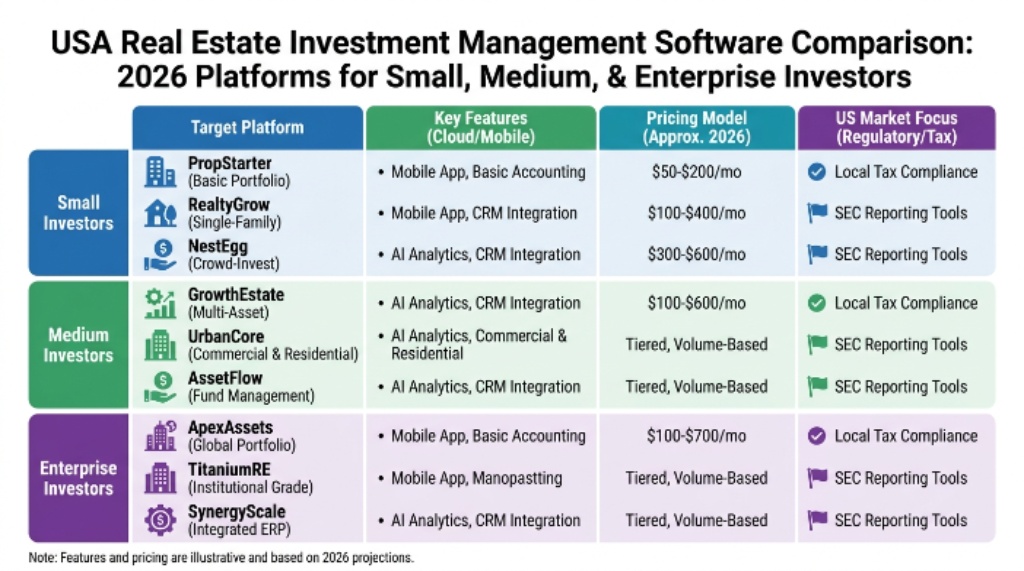
Side-by-Side Comparison
| Software | Best For | Starting Price | Key Strength |
| Stessa | Solo and small investors | Free | Automated tracking and tax prep |
| DealCheck | Active deal analyzers | Low cost | Scenario modeling and deal analysis |
| Buildium | Self-managing landlords | From $55 per month | Unified leasing and accounting |
| AppFolio | Mid-market operators | From $1.40 per unit per month | AI automation and investor reporting |
| InvestNext | Syndicators and fund managers | Custom | Investor relations and capital raising |
| Yardi Breeze | Growing portfolios | Modular pricing | Ease of use within the Yardi ecosystem |
| Yardi Voyager | Large institutional operators | From $200 per month | Full-stack enterprise management |
| ARGUS Enterprise | Institutional investors | Custom | Advanced valuation and analytics |
| MRI Software | Complex enterprise operators | Custom | Configurability and compliance |
How to Choose the Right Platform for Your Portfolio
Choosing the right tool starts with an honest assessment of where your business is today and where you expect it to be in three years. Small investors who plan to scale quickly may benefit from starting on a platform that grows with them rather than switching systems later.
Property type matters as well. Multifamily investors often find AppFolio and Yardi Breeze well-suited to their needs. Commercial and mixed-use operators may need the deeper analytical tools that ARGUS or Yardi Voyager offer. Syndicators raising capital from outside investors should prioritize platforms like InvestNext or IMS that are built specifically for that workflow.
Additionally, integration is a critical factor. Your software should connect cleanly with your accounting system, banking tools, and any third-party platforms your team already uses. The best platform is the one that fits your process, reduces your manual work, and produces reports you can confidently share with investors, lenders, and advisors.
Conclusion
The best real estate investment management software in 2026 depends entirely on the scale and complexity of your portfolio. Small investors benefit most from accessible, affordable tools like Stessa and Buildium that handle everyday tracking and tax preparation with minimal setup. Mid-market operators managing 50 to 500 units will find AppFolio, InvestNext, and Yardi Breeze strong choices for combining operational efficiency with investor-grade reporting. Enterprise investors and institutional funds require the depth and compliance capabilities that Yardi Voyager, ARGUS Enterprise, and MRI Software deliver. Across all three tiers, the common thread is clear: the right software removes friction, improves accuracy, and gives you the financial visibility you need to make confident investment decisions at any scale.
Frequently Asked Questions
What is the best free real estate investment management software for small investors in the USA?
Stessa is widely considered the best free option for small investors in the USA. It automates income and expense tracking by connecting to bank accounts, generates tax-ready reports including Schedule E, and provides real-time portfolio performance dashboards at no cost for its core tier.
What software do real estate syndicators use to manage investor relations?
Real estate syndicators commonly use platforms such as InvestNext, IMS (Investor Management Services), and Cash Flow Portal to manage investor relations. These tools handle investor portals, waterfall distributions, capital call tracking, document management, and regulatory reporting for private placement offerings.
Is AppFolio suitable for commercial real estate investors?
AppFolio supports both residential and commercial property management, though it is strongest for mid-market residential operators. For complex commercial real estate analysis and institutional-level valuation, platforms like ARGUS Enterprise and Yardi Voyager offer more specialized capabilities.
What is ARGUS Enterprise used for in real estate?
ARGUS Enterprise is used primarily for institutional-grade commercial property valuation, cash flow modeling, and portfolio-level risk analysis. It is the industry standard tool among large real estate investment funds, asset managers, and commercial lenders that require detailed, defensible financial projections across multi-asset portfolios.
Can small investors use enterprise-level real estate software?
In most cases, enterprise platforms like Yardi Voyager and ARGUS Enterprise are not cost-effective or practical for small investors. They are designed for complex, large-scale operations and typically require dedicated implementation teams. Small investors are better served by accessible platforms like Stessa, Buildium, or DealCheck, which provide professional features without the overhead of an enterprise system.


