
Managing a real estate portfolio in 2026 looks nothing like it did five years ago. Investor expectations have shifted. Reporting cycles have shortened. Regulatory requirements keep growing. Firms that still rely on spreadsheets and email chains are falling behind. The right software platform changes all of that.
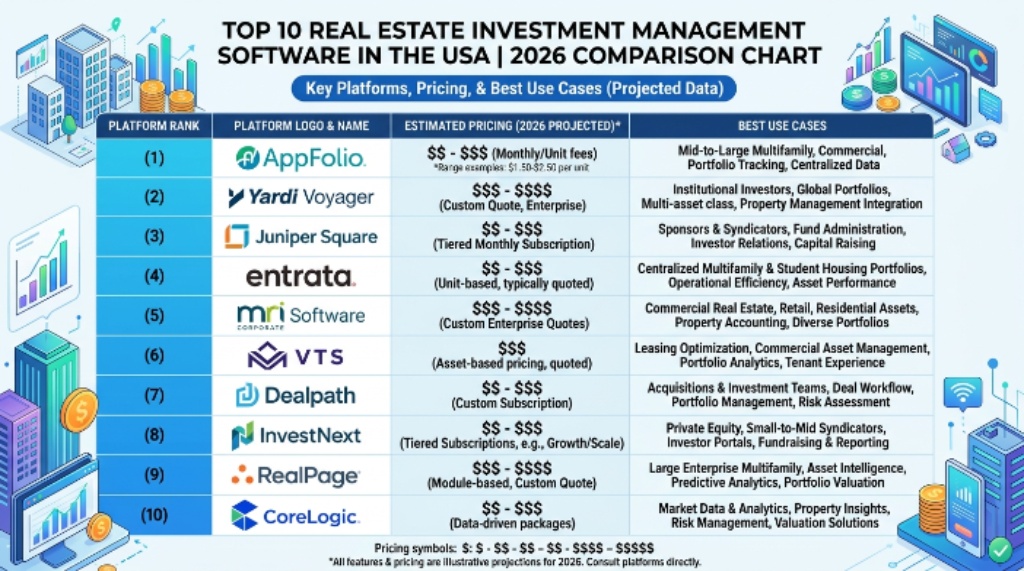
This guide compares the ten leading real estate investment management software platforms available to US-based firms in 2026. Each platform is assessed on its core strengths, ideal user profile, and pricing tier to help you make an informed decision quickly.
What to Look for Before You Choose
Not every platform serves the same type of investor. Before comparing options, it helps to identify which stage of the investment lifecycle matters most to your firm. The key capabilities to evaluate include:
- Investor portal quality and branded experience
- Automated distribution and waterfall calculations
- Deal tracking and pipeline management
- Integrated accounting and K-1 delivery
- Reporting and compliance tools
- Integration with existing property management systems
- Scalability across portfolio size and entity structures
Once you know which capabilities your team needs most, narrowing the field becomes much easier.
Quick Comparison: All 10 Platforms at a Glance
| Platform | Best For | Starting Price |
| Agora | CRE firms needing full customization and blockchain security | From $749/month |
| Juniper Square | Large institutional firms and scaling GPs | From $1,500/month |
| AppFolio Investment Manager | Firms already using AppFolio property management | From $650/month |
| InvestNext | Growing sponsors seeking affordability and automation | From $499/month |
| Yardi Investment Suite | Enterprise firms needing deep accounting integration | Custom pricing |
| RealPage IMS | Firms operating within the RealPage ecosystem | Custom pricing |
| Covercy | Firms prioritizing integrated banking and instant payments | From $500/month (est.) |
| Dealpath | Deal management and pipeline tracking across large institutions | Custom pricing |
| Cash Flow Portal | Budget-conscious syndicators and first-time GPs | From $99/month |
| SyndicationPro | White-label syndication with co-sponsorship capabilities | From $400/month (est.) |
The 10 Best Platforms Reviewed
-
Agora
Agora markets itself as the global operating system for real estate investment management. It targets commercial real estate general partners and fund managers who want a single platform for both investor relations and back-office operations.
The platform covers the full accounting lifecycle, including reconciliation, ongoing book management, K-1 delivery, and tax preparation. It also offers a fully branded investor portal and supports more than 5,000 prebuilt integrations. Agora was notably the first investment management platform in this category to use blockchain technology for enhanced transparency and document security.
Pricing starts at $749 per month. It works best for CRE-focused teams managing under $250 million in assets under management who need fast deployment and strong customization without enterprise-level costs.
-
Juniper Square
Juniper Square is widely considered the most credentialed platform for large commercial real estate firms. It serves institutional GPs, fund managers, and large syndicators who manage $500 million or more in AUM. The platform handles investor relations, fundraising, CRM, deal tracking, and reporting in a unified environment.
Its investor portal is polished and highly regarded among limited partners. However, its pricing starts at $1,500 per month or more, and its out-of-the-box integrations are more limited than some competitors. Therefore, smaller firms or those early in their growth journey may find the cost difficult to justify.
-
AppFolio Investment Manager
AppFolio Investment Manager is the institutional arm of the widely used AppFolio property management platform. It combines investment management tools with the underlying property operations stack, making it particularly valuable for firms that want a single vendor covering both sides of the business.
Key features include an AI-powered investor portal, automated workflows, mobile-first design, CRM functionality, and detailed reporting. Pricing starts at approximately $650 per month and scales with portfolio size. Firms not already using AppFolio for property management will find less differentiation here, but for existing AppFolio users, the integration is genuinely seamless.
-
InvestNext
InvestNext positions itself as the best value all-in-one tool for growing real estate sponsors. It offers a strong combination of automation, CRM integration, investor portal quality, and deal management features at a starting price of $499 per month. Many sponsors report rapid onboarding, often completing setup within a few days.
Additionally, InvestNext includes a visual waterfall builder that allows sponsors to model complex distribution structures without needing outside help. It serves the mid-market well and competes closely with Agora and AppFolio for teams between $10 million and $250 million in AUM.
-
Yardi Investment Suite
Yardi is one of the largest names in real estate technology. Its Investment Suite is designed for enterprise-scale firms that need sophisticated accounting capabilities alongside investor management. The platform handles consolidations, eliminations, allocations, and complex fee calculations across large, multi-entity portfolios.
Pricing is custom and aimed at institutional clients. Yardi’s breadth of products means integration across property management, accounting, and investment management is tighter than almost any other option on this list. However, the platform carries a steeper implementation curve and higher total cost of ownership than mid-market alternatives.
-
RealPage IMS (Investor Management Services)
RealPage IMS describes itself as the only all-in-one investment management platform in its category. It covers deal management, investor communications, distribution processing, and reporting. The platform is widely respected among growing sponsors in the $50 million to $500 million AUM range.
Pricing is custom and enterprise-oriented. Firms already embedded in the RealPage ecosystem benefit the most, as product integration across RealPage’s broader suite is a key strength. For firms outside that ecosystem, there are more flexible options at lower price points.
-
Covercy
Covercy stands out as the only platform on this list that fully integrates banking and payments within its investment management tool. General partners can transfer distributions to limited partners instantly, and investors can fund capital calls with a single click. No third-party payment processor is needed.
The platform targets smaller to mid-sized commercial real estate firms. Pricing is estimated at $500 or more per month and requires a sales conversation to confirm. Covercy also offers a free tier for portfolios of up to three assets, which is a useful entry point for first-time syndicators who want to test the platform before committing.
-
Dealpath
Dealpath is a purpose-built deal management and pipeline tracking platform. It is trusted by some of the largest institutions in real estate, including Blackstone, AEW, and Oxford Properties. Its core strength is workflow management across complex deal processes, from initial screening and underwriting through approval and closing.
Dealpath is not a full investor relations or distribution platform. Rather, it serves as the deal execution layer for teams that need rigorous process control across large transaction volumes. Pricing is custom. It integrates with most major real estate platforms and excels when used alongside a broader investor management solution.
-
Cash Flow Portal
Cash Flow Portal is the most affordable option on this list, with plans starting at $99 per month. It targets first-time syndicators, emerging GPs, and budget-conscious operators who need a clean, intuitive platform to manage investor relations and syndication workflows without a heavy price tag.
Features include an investor portal, document management, distribution tracking, and basic reporting. It lacks the depth of enterprise platforms, but for sponsors getting started or managing a small number of assets, it delivers strong value at a low entry cost. Implementation is typically fast, making it a practical choice for teams that need to launch quickly.
-
SyndicationPro
SyndicationPro is a white-label syndication platform with co-sponsorship capabilities. It lets sponsors offer a fully branded investor experience under their own company identity. The co-sponsorship feature is relatively uncommon among competitors and makes it a strong choice for joint-venture structures.
Pricing is estimated between $400 and $600 per month, though exact figures require a sales conversation. The platform is user-friendly and accessible for sponsors without large technical teams. However, it is lighter on advanced functionality than platforms like Agora, Juniper Square, or Yardi, making it best suited for sponsors in the early to mid stages of growth.

How to Choose the Right Platform for Your Firm
The decision comes down to three factors: firm size, budget, and the capabilities you need most.
| Firm Profile | Recommended Platform |
| First-time syndicator, tight budget | Cash Flow Portal |
| First-time syndicator wanting more depth | Covercy or SyndicationPro |
| Growing sponsor, $10M to $100M AUM | InvestNext or AppFolio IM |
| Mid-market, $100M to $500M AUM | Agora or InvestNext |
| Institutional, $500M+ AUM | Juniper Square or RealPage IMS |
| Deal pipeline management priority | Dealpath |
| AppFolio property management users | AppFolio Investment Manager |
| Banking and payment integration priority | Covercy |
| Enterprise accounting and multi-entity complexity | Yardi Investment Suite |
One practical tip: ask each vendor for a live demo focused on your specific portfolio structure. Generic demos often highlight strengths and gloss over limitations. A scenario-specific walkthrough reveals far more.
Additionally, check integration depth before committing. If your team already uses Yardi, AppFolio, or another property management system, a platform that connects natively will save significant time and reduce data errors across your reporting cycle.
Conclusion
Choosing the right real estate investment management software is one of the most consequential technology decisions a US-based investment firm makes in 2026. The ten platforms reviewed here cover the full spectrum of firm sizes and use cases. Agora and InvestNext serve the growing mid-market well, with strong customization and competitive pricing. Juniper Square and RealPage IMS anchor the institutional end of the market. AppFolio Investment Manager is the clear choice for firms already operating within the AppFolio ecosystem. Covercy leads on payment integration.
Cash Flow Portal offers the most accessible entry point for new syndicators. Dealpath excels as a deal management layer for complex institutional transaction pipelines. SyndicationPro suits joint-venture sponsors who need white-label flexibility. Yardi Investment Suite remains the enterprise standard for firms with multi-entity accounting complexity. Review your firm’s current stage, budget, and integration needs, then request live demos from your top two or three candidates before making a final decision.
Frequently Asked Questions
What is real estate investment management software and who needs it?
Real estate investment management software is a platform that helps general partners, fund managers, and syndicators manage investor relations, deal tracking, distributions, reporting, and compliance in one place. Any firm raising capital from multiple investors, managing a portfolio of properties, or processing regular distributions benefits from using a dedicated platform rather than spreadsheets and manual processes.
How much does real estate investment management software cost in 2026?
Pricing ranges widely. Entry-level platforms like Cash Flow Portal start at $99 per month. Mid-market platforms like InvestNext, AppFolio Investment Manager, and Agora range from $499 to $749 per month. Enterprise solutions like Juniper Square and Yardi Investment Suite use custom pricing, often starting at $1,500 per month or more. Most platforms offer annual contracts and do not publish pricing for enterprise tiers.
Which platform is best for a first-time real estate syndicator?
Cash Flow Portal is the most accessible starting point, with plans from $99 per month and a straightforward interface. Covercy offers a free tier for up to three assets, making it another low-risk option. SyndicationPro suits joint-venture structures with its white-label capabilities. First-time syndicators should prioritize ease of use, fast onboarding, and core investor portal functionality over advanced features they may not need yet.
What features should I look for in a real estate investment management platform?
The most important features for most firms include a branded investor portal with document access, automated distribution calculations and waterfall modeling, deal tracking and CRM tools, integrated accounting with K-1 preparation and delivery, reporting dashboards, and integrations with your existing property management system. Larger firms should also prioritize multi-entity support and compliance reporting.
How long does it take to implement a new platform?
Implementation timelines vary by platform complexity and firm size. Simpler platforms like Cash Flow Portal and InvestNext typically take one to two weeks to set up. Mid-market platforms like Agora and AppFolio Investment Manager average two to four weeks. Enterprise platforms like Yardi Investment Suite and Juniper Square can take two to three months for full deployment, especially when migrating historical data from previous systems.