
Commercial vacuum cleaners are built for frequent, heavy-duty use in large spaces, while residential vacuums are designed for lighter, occasional cleaning in homes.
Here’s the reality most buyers miss: choosing the wrong type doesn’t just affect cleaning—it impacts cost, durability, and productivity.
Imagine this. You buy a home vacuum for your office to save money. Within months, it overheats, loses suction, and needs replacement. Now your “cheap” option costs more than a proper commercial machine.
On the flip side, buying a commercial vacuum for a small apartment may feel like overkill—louder, heavier, and more expensive than needed.
This guide breaks down the office vacuum comparison, explains heavy-duty vs home vacuum differences, and helps you choose the right cleaning equipment without wasting money.
Why does choosing the wrong vacuum cleaner become a problem?
Short answer: The wrong vacuum leads to faster wear, poor cleaning results, and higher long-term costs.
Most people think a vacuum is just a vacuum. That assumption causes problems.
The Problem
- Residential vacuums are not designed for 6–8 hours of daily use.
- Commercial vacuums may be too powerful and inefficient for small homes.
- Maintenance costs increase when machines are misused.
The Agitation
According to cleaning industry reports, home vacuums used in commercial settings can fail 2–3x faster than intended. Motors burn out. Filters clog faster. Downtime increases.
In offices, downtime means lost productivity. In homes, it means frustration.
The Solution
Understand the core differences in cleaning equipment types before buying. The right machine saves money over time and delivers consistent results.
What are commercial vacuum cleaners designed for?
Short answer: Commercial vacuums are built for durability, long operating hours, and large-scale cleaning.
Key Features
- Heavy-duty motors (often 1000W–1500W or higher)
- Large dust capacity
- Continuous operation capability
- Stronger suction for carpets and hard floors
- Durable materials (metal or reinforced plastic)
Where they are used
- Offices
- Hotels
- Hospitals
- Retail stores
- Industrial environments
Case Insight
A mid-sized office (5,000 sq ft) switching from residential vacuums to commercial units reported:
- 30% reduction in cleaning time
- 50% fewer maintenance issues
- Improved carpet lifespan due to consistent suction
This shows how proper office vacuum comparison impacts real business outcomes.
What are residential vacuum cleaners designed for?
Short answer: Residential vacuums are designed for convenience, lightweight use, and smaller spaces.
Key Features
- Lightweight and portable
- Lower power consumption
- Quieter operation
- Compact design for storage
- Multi-purpose attachments
Where they are used
- Apartments
- Small homes
- Personal cleaning tasks
Limitations
- Not suitable for long cleaning sessions
- Smaller dust bins require frequent emptying
- Shorter lifespan under heavy use
In a heavy-duty vs home vacuum comparison, residential units win on convenience but lose on endurance.
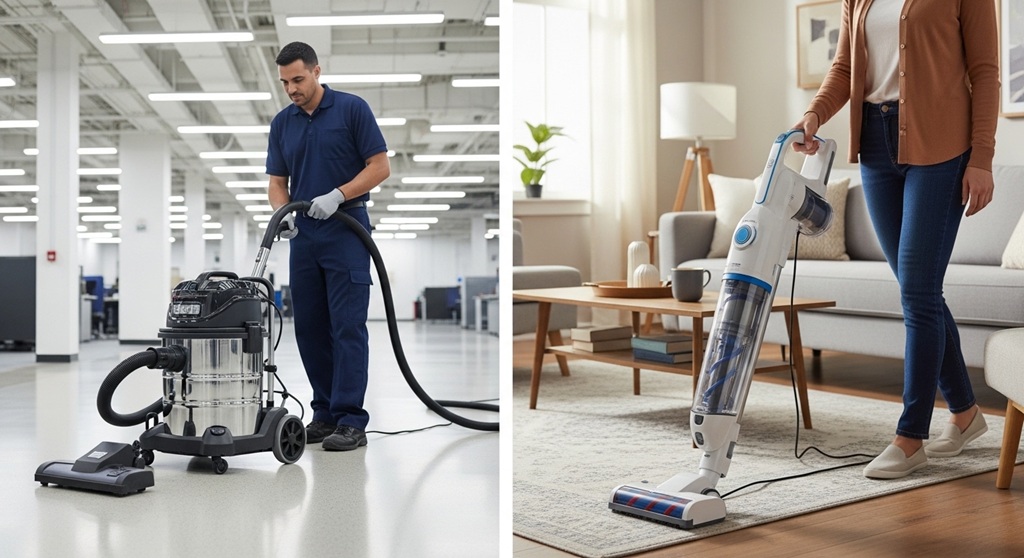
How do commercial and residential vacuums compare side by side?
Short answer: Commercial vacuums prioritize durability and power, while residential vacuums focus on ease of use and affordability.
| Feature | Commercial Vacuum | Residential Vacuum |
|---|---|---|
| Usage | Daily, long hours | Occasional cleaning |
| Durability | High | Moderate |
| Suction Power | Strong | Moderate |
| Weight | Heavier | Lightweight |
| Noise Level | Louder | Quieter |
| Cost | Higher upfront | Lower upfront |
| Maintenance | Less frequent | More frequent |
Which vacuum is more cost-effective in the long run?
Short answer: Commercial vacuums are more cost-effective for frequent use, while residential vacuums are cheaper for occasional cleaning.
The Problem
Many buyers focus only on upfront cost.
The Agitation
A residential vacuum costing $150 may need replacement within a year in a commercial setting. A $500 commercial vacuum may last 3–5 years.
The Solution
Calculate total cost of ownership:
- Initial price
- Maintenance cost
- Replacement frequency
In most heavy-duty vs home vacuum scenarios, commercial units win for business use.
How does performance differ in real cleaning scenarios?
Short answer: Commercial vacuums maintain consistent suction over time, while residential vacuums may lose efficiency during extended use.
Real-World Example
In a hotel cleaning test:
- Commercial vacuum cleaned 20 rooms without overheating
- Residential vacuum needed cooling breaks after 6–8 rooms
Why this matters
- Consistent suction improves cleaning quality
- Less downtime increases productivity
- Better dust removal improves indoor air quality
Are commercial vacuums harder to use?
Short answer: They are slightly heavier but designed for efficiency and repetitive tasks.
Key Considerations
- Ergonomic handles reduce strain
- Wider cleaning paths save time
- Backpack models improve mobility
While residential vacuums feel easier initially, commercial models are optimized for long-term usability.
What types of vacuum cleaners fall under each category?
Short answer: Both categories include multiple designs, but they differ in build and purpose.
Commercial Cleaning Equipment Types
- Upright commercial vacuums
- Backpack vacuums
- Wet/dry industrial vacuums
- Canister commercial vacuums
Residential Cleaning Equipment Types
- Stick vacuums
- Robot vacuums
- Handheld vacuums
- Standard upright models
Understanding cleaning equipment types helps match the tool to the task.
Which vacuum should you choose for your needs?
Short answer: Choose commercial for frequent, large-scale cleaning; choose residential for small, occasional use.
Choose Commercial If:
- You clean daily
- You manage large spaces
- You need durability
- You run a business or facility
Choose Residential If:
- You clean occasionally
- You have limited space
- You prioritize portability
- You want lower upfront cost
This simple framework removes confusion in any office vacuum comparison.
Conclusion: What’s the smarter investment?
Choosing between commercial and residential vacuum cleaners isn’t about price—it’s about purpose.
If you use a vacuum occasionally at home, a residential model is enough. It’s lightweight, affordable, and convenient.
But if you clean large spaces or operate daily, a commercial vacuum is the smarter investment. It lasts longer, performs better, and reduces long-term costs.
The key takeaway: match the machine to the workload.
CTA: Before buying your next vacuum, assess how often and where you’ll use it. Compare features, calculate long-term costs, and choose a model that fits your real needs—not just your budget.
Frequently Asked Questions (FAQs)
Is a commercial vacuum worth it for home use?
Short answer: Usually no, unless you have a large home or heavy cleaning needs.
Commercial vacuums are heavier and louder. For standard homes, residential models are more practical.
Do commercial vacuums last longer?
Short answer: Yes, they are built for durability.
They use stronger components and can handle continuous use, making them last significantly longer than home vacuums.
Are commercial vacuums more powerful?
Short answer: Yes, they offer stronger and more consistent suction.
This makes them ideal for deep cleaning carpets and large areas.
Can I use a residential vacuum in an office?
Short answer: Yes, but it’s not recommended for long-term use.
Frequent use can lead to faster wear and higher replacement costs.
What is the biggest difference in maintenance?
Short answer: Commercial vacuums require less frequent maintenance.
They have larger dust bins and better filtration systems designed for heavy use.
Which vacuum is better for carpets?
Short answer: Commercial vacuums perform better on carpets.
They provide deeper cleaning due to stronger suction and wider cleaning heads.
Are commercial vacuums energy efficient?
Short answer: They consume more power but are efficient for large-scale cleaning.
Their efficiency comes from completing tasks faster and reducing repeated cleaning cycles.
Read More Also: How to Choose a Heavy-Duty Projector Stand for Professional Use
Find out: How to Sell a Business and Prepare Documents Buyers Actually Want


