It’s worth reading Punchline Gloucester’s profile of Poeton’s surface treatment business in full.
You receive a quote for a bearing sleeve made from some exotic alloy only to discover that the part costs more than the gearbox it is going to be used in. The pretty datasheet does not make up for the desperate look in the purchasing manager’s eyes.
The profile describes a unique business helping manufacturers get the best out of standard materials. The comparison with exotic wearing parts is however very straightforward for a startup with tiny runs to make – you price the surface treatment of standard materials as if it were part of the set-up cost.
A founder with a wearing part
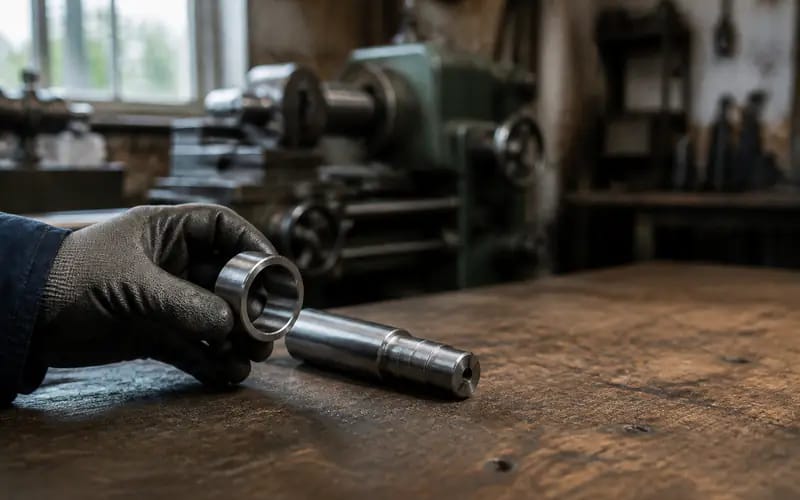
Startups make smallest quantities of highest variety. That startup building a small batch filling machine has a bearing of a wearing shaft/sleeve arrangement. The bearing is of hardest material i.e. an exotic alloy – or has it been surface treated to get the wear required from standard engineering materials?
Why treated alloys can beat exotic ones
Wear is surface. Thus surface treatments can make harder wearing parts from conventional alloys, whilst retaining the core properties of those conventional alloys (toughness, machinability, cost per kg etc.). In volume production, the cost of a surface treatment spread thinly over the volume of parts to be produced typically means that the treated conventional alloy will be cheaper than the exotic alloy.
Small runs change the economics
The cost of the treatment set-up is spread over the batch size of parts (eg. 10 parts or 10,000 parts), so at small run sizes an exotic bar (once machined) can sometimes compete on cost with a treated common material bar. Some surface treated materials are even tested on small trial lots of parts (such as prototypes) to assess their surface finish properties before starting production.
Poeton has around 120 staff based in Gloucester, with further facilities in Cardiff and in Poland. For a startup, minimum order quantity and lead time are likely to be of greatest interest.
Lead time and repeatability
The process of surface treatment of common materials adds a step or stages to your current processes and therefore adds days and possibly enters your process into a queue. When comparing exotic materials to surface treatment of common materials both will have a wait time, so ensure you are comparing like with like. Repeatability is key to surface treatment of common materials allowing consistent surface finish to be reproduced batch after batch.
Where the idea holds and where it bends
The majority of wear parts can be cost effectively treated on standard materials but when making tiny runs a start-up need to check the share of set-up costs on both options.
Consider ordering both options and comparing a proper quote for your first batch run, showing the set-up cost as a separate line item on the invoice. This should quickly indicate where the crossover point is for you.
Related posts:

From Passion to Profit: Launching Your Thriving Interior Design Business

How to start a laundry business?

Save the Environment and Your Wallet With Solar Panels

Voice commands: How digital assistants revolutionize business

Why it's time to stop measuring the effectiveness of advertising in leads?

12 Profitable Business Ideas 2018 Start with Amazon

Streamlining Payroll Processes: How HR and Payroll Management Companies Can Help